On this page
Secrets of the Tribe had everything going for them. 547 products. 4.9-star reviews from 2,700+ customers. A family story that started with a healing experience in Singapore. The products were real. The customer loyalty was real.
The website was the problem.
They were competing against Gaia Herbs, a $50M+ company with 38 years of heritage. Gaia’s website set customer expectations for what an herbal supplements store should look like. Secrets of the Tribe showed up with a basic Shopify template and three filter options for 300+ products.
Great business. Bad presentation. Money left on the table every day.
Works Well For: Is This Case Study Relevant to You?
Before you read further, let me save you time. This case study is most relevant if you:
- Have a product catalog over 50 items and customers can’t find what they need
- Compete against bigger players who make you look small by comparison
- Have strong reviews and repeat customers but your website doesn’t reflect that quality
- Sell online through Shopify, WooCommerce, or similar platforms
- Know your website is holding you back but aren’t sure what specifically to fix
If you’re a service business with no products, or if your main problem is getting traffic (not converting it), this case study won’t be as useful. I have other examples that might fit better.
The Client’s Situation Before: A Business Owner’s Familiar Problem
Here’s what the founders of Secrets of the Tribe were dealing with. See if any of this sounds familiar.
By the time they came to me, they had:
- 547+ products across multiple categories
- 4.9-star rating from 2,700+ customer reviews
- A product line that genuinely competed with industry giants
- Customers who loved their products and kept coming back
What they didn’t have was a website that reflected any of this.
The gap between their business quality and their online presentation was costing them sales every single day. Visitors comparing them to Gaia Herbs weren’t seeing the quality difference. They were seeing a presentation gap. And they were making assumptions: “Small operation. Maybe not trustworthy. I’ll buy from the bigger brand.”
This is a problem I see constantly with growing businesses. You’ve built something real. Customers who find you love you. But your website still looks like it did when you were just getting started. And every day that gap exists, you’re losing sales to competitors who simply look more professional.
The Problem: Specifically, What Was Broken
Here’s what I found when I dug into the user experience.
Product Discovery Was Broken
300+ products. Three filter options. That’s it. Users scrolled through endless pages or hoped the search function could read their minds. Hotjar heatmaps showed users clicking around without direction, trying to find products. Some gave up. The ones who stayed spent more time navigating than shopping.
For a business owner, this translates directly to lost revenue. Every customer who gives up is a sale that went to a competitor instead.
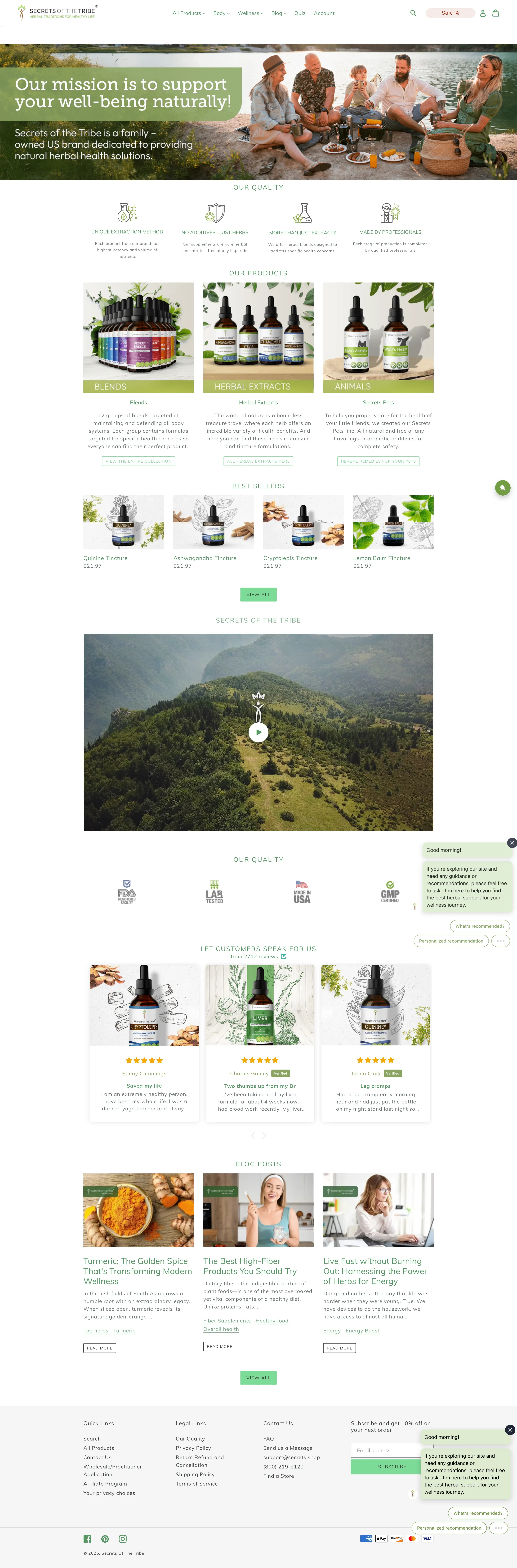 Before: Basic Shopify template with only 3 filter options for 300+ products
Trust Signals Were Invisible
Secrets of the Tribe had real credentials: GMP certified, FDA registered facilities, third-party lab testing. But these badges were buried in footer text. A first-time visitor comparing them to Gaia Herbs wouldn’t see any of this. They’d see a generic template and assume “small operation, maybe not trustworthy.”
The Competition Set Different Expectations
Gaia Herbs has a beautiful website. Sophisticated filtering. Premium photography. Professional everything. When a potential customer visits Secrets of the Tribe after browsing Gaia, the comparison is immediate. Even if Secrets of the Tribe had better products at better prices, the website made them look second-tier.
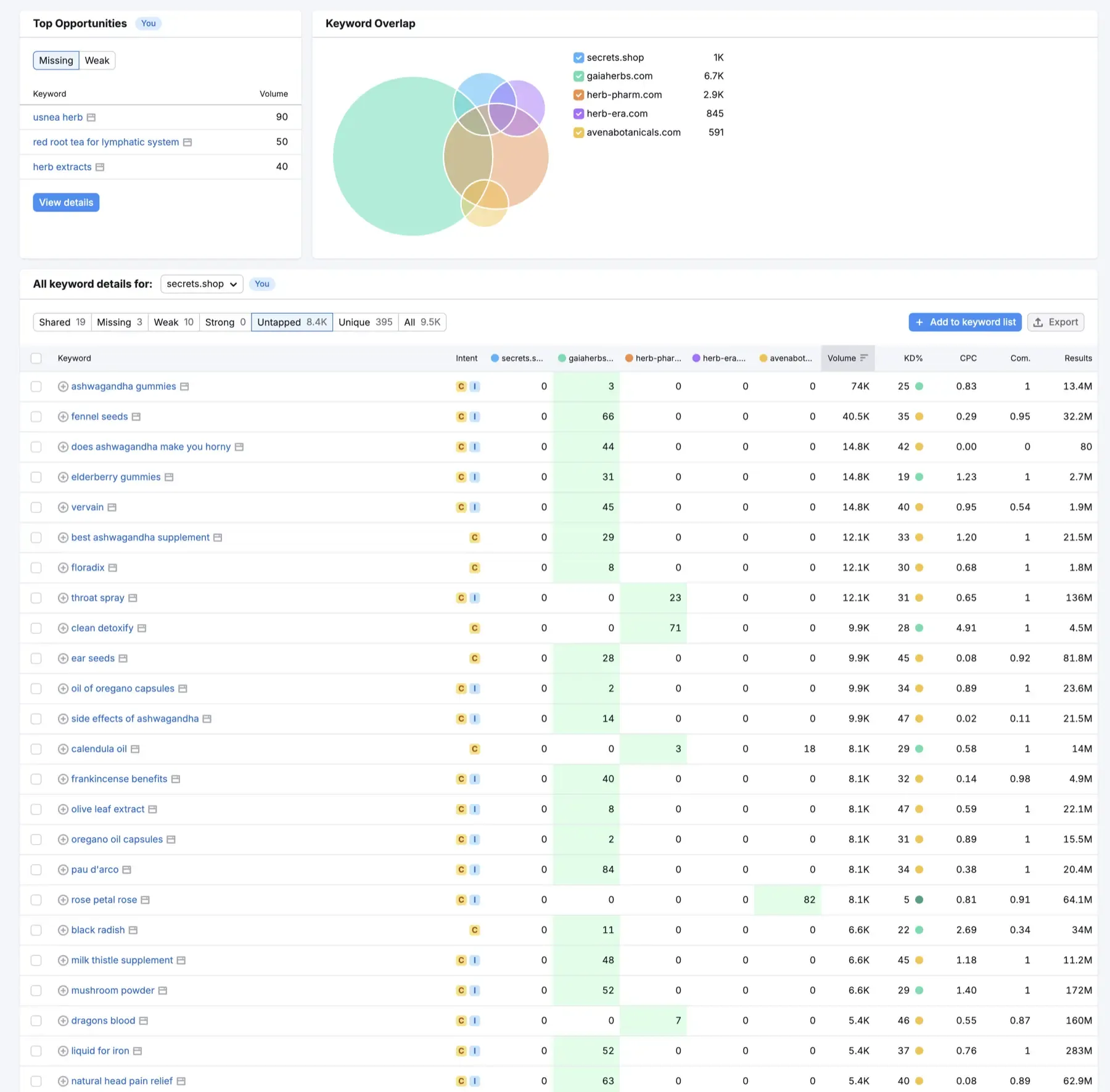 Competitive analysis: Identifying opportunities where Secrets of the Tribe could outrank industry giants
The Real Business Cost
This wasn’t a design problem. It was a revenue problem. Every day the website experience didn’t match the product quality, customers walked out the door. Customers who would have loved these products never got past the first impression.
If your business has great products or services but customers hesitate to buy, the issue is usually trust or friction. Both are fixable.
The Insight: What I Found That Changed Everything
Before I touched a single design element, I spent time on a 31-page competitive analysis comparing Secrets of the Tribe to Gaia Herbs. UX audit. Pricing comparison. Information architecture. Content gaps. Trust signal placement. Strategic positioning.
Here’s what I found that changed everything.
Secrets of the Tribe had MORE products than Gaia Herbs. 547+ versus roughly 200+. Their pricing was competitive, sometimes better. Their customer reviews were exceptional. They weren’t losing on substance. They were losing on presentation and product discovery.
Most agencies would look at a 547-product catalog and see a problem: too many SKUs, hard to organize, confusing for users. They’d sell you a “comprehensive digital strategy” and deliver a template with your logo slapped on it. I saw the opposite.
That product breadth was actually a competitive advantage.
When you have twice the products of your main competitor, you can serve niche needs they can’t. Someone looking for a specific herb or formulation is more likely to find it with you. But only if they can actually discover it.
The problem wasn’t “too many products.” The problem was “no way to find them.”
This insight shaped every design decision that followed.
What I Actually Did: No Black Box
Let me be clear about my role. I don’t hide behind vague “strategies” or confusing reports. You work directly with me. No account managers, no runaround.
I handled strategy, competitive analysis, UX/UI design, and development specifications. The actual Shopify development was done by ESEO Space, my development partner in San Diego. We’ve built 40+ websites together over four years. They’re specialists at what they do.
This is how I work: direct access, clear deliverables, and no mystery about where your money goes.
Here’s exactly what I delivered:
31-Page Competitive Analysis
Not a template. Original research comparing Secrets of the Tribe against Gaia Herbs across:
- User experience patterns and friction points
- Pricing architecture and value perception
- Information architecture and navigation
- Content gaps and SEO opportunities
- Trust signal placement and prominence
- Strategic positioning recommendations
This document drove every decision that followed. No guesswork. No “let’s try this and see.” You’d get the same level of analysis for your business.
SEO Research and Content Strategy
Keyword research that identified ranking opportunities. Content gap analysis showing where Secrets of the Tribe could win against larger competitors. URL structure planning to maintain their 3,200+ existing keyword rankings during the redesign.
Complete UX/UI Redesign
- Homepage that communicated quality and trust immediately
- Collection pages with advanced filtering for 300+ products
- Product pages built to sell, not just display
- Mobile-first experience (their mobile traffic was significant)
- Trust architecture with prominent certification badges
Sales Architecture
Pathways designed for different buyer types. Clear CTAs. Reduced friction. Trust signals positioned for impact, not hidden in footers. Every page exists to help someone decide to buy. If it doesn’t do that job, it doesn’t go live.
Development Specifications
Detailed specs handed to ESEO Space covering every functional requirement. This is how I work: I design and strategize, then hand off precise documentation for development.
What Got Built: Beyond a Template Swap
ESEO Space took my specifications and built features that went well beyond a standard Shopify theme. This wasn’t a template install with custom colors.
AI Product Recommendation Agent
A conversational product finder that helps users who don’t know exactly what they’re looking for. Type a question or describe what you need, and the AI suggests relevant products. This solved the “I don’t know where to start” problem that overwhelmed first-time visitors.
Product-Matching Quiz
For users who prefer a guided experience over AI chat. Answer a few questions about your health goals, and the quiz recommends products matched to your needs. Especially useful for the herbal supplements audience, where many buyers are exploring rather than searching for a specific SKU.
Real-Time Search With Instant Results
Type a keyword and see results immediately, not after a page reload. For a 547-product catalog, this speed matters. Users find what they need faster, which means they’re more likely to buy.
Multi-Attribute Filtering System
This was the core fix for product discovery. Users can now filter by:
- Category
- Form factor (tincture, capsule, tea, etc.)
- Health concern
- Key ingredients
Narrow 300+ products to exactly what you need in 2-3 clicks. The filtering system that should have existed from day one.
 After: Multi-attribute filtering narrows 300+ products in 2-3 clicks
Results in Context: Honest Numbers With Caveats
Three months after launch, here’s where Secrets of the Tribe stands. I’ll give you the numbers AND the context, because numbers without context can be misleading.
Technical Performance: Core Web Vitals Passed
Google measures loading speed (LCP), interactivity (INP), and visual stability (CLS). Secrets of the Tribe passed all three on both mobile and desktop.
| Metric | Desktop | Mobile |
|---|---|---|
| LCP (Largest Contentful Paint) | 2.2s | 1.6s |
| INP (Interaction to Next Paint) | 109ms | 164ms |
| CLS (Cumulative Layout Shift) | 0 | 0 |
What this means for you: Mobile LCP of 1.6 seconds means customers see products fast, not loading spinners. For e-commerce, every second of delay costs you about 7% in sales. A slow site is a leaky bucket, money walking out the door while you sleep.
Search Performance: 49+ Position 1 Rankings
The redesign didn’t just maintain SEO. It improved it.
- 3,277 total keywords ranking (up from 3,200+)
- 64 keywords in top 3 positions
- 49+ Position 1 rankings for high-value terms
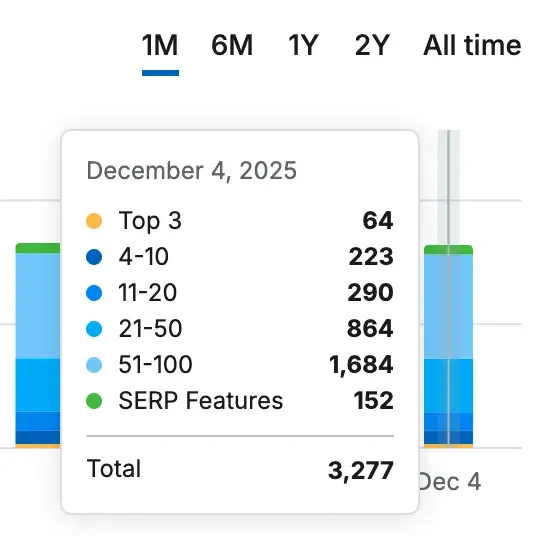 Ranking distribution: 64 top-3 positions, 3,277 total keywords
Here are some of the Position 1 rankings with monthly search volume:
| Keyword | Monthly Search Volume | Position |
|---|---|---|
| lambs ear vs mullein | 1,000 | 1 |
| mullein vs lambs ear | 880 | 1 |
| pine pollen tincture | 590 | 1 |
| kelp and seaweed | 480 | 1 |
| is kelp the same as seaweed | 390 | 1 |
What this means for you: These are buyers, not browsers. People searching “pine pollen tincture” aren’t doing casual research. They’re ready to buy. Owning Position 1 for these terms means capturing demand at the moment of decision. Every Position 1 ranking is a stream of customers finding you instead of your competitors. Rankings don’t matter if they don’t turn into revenue. These do.
The honest caveat: Secrets of the Tribe already had strong SEO foundations before the redesign. We didn’t build this from zero. We protected what existed and built on top of it. If your site has no SEO foundation, results would look different (and take longer).
UX Improvements: From Frustrated to Functional
- Complete filtering system for 300+ products (vs. 3 filters before)
- Intelligent product discovery via AI agent, quiz, and real-time search
- Trust architecture with certification badges visible above the fold
- Mobile-first design matching where their traffic actually comes from
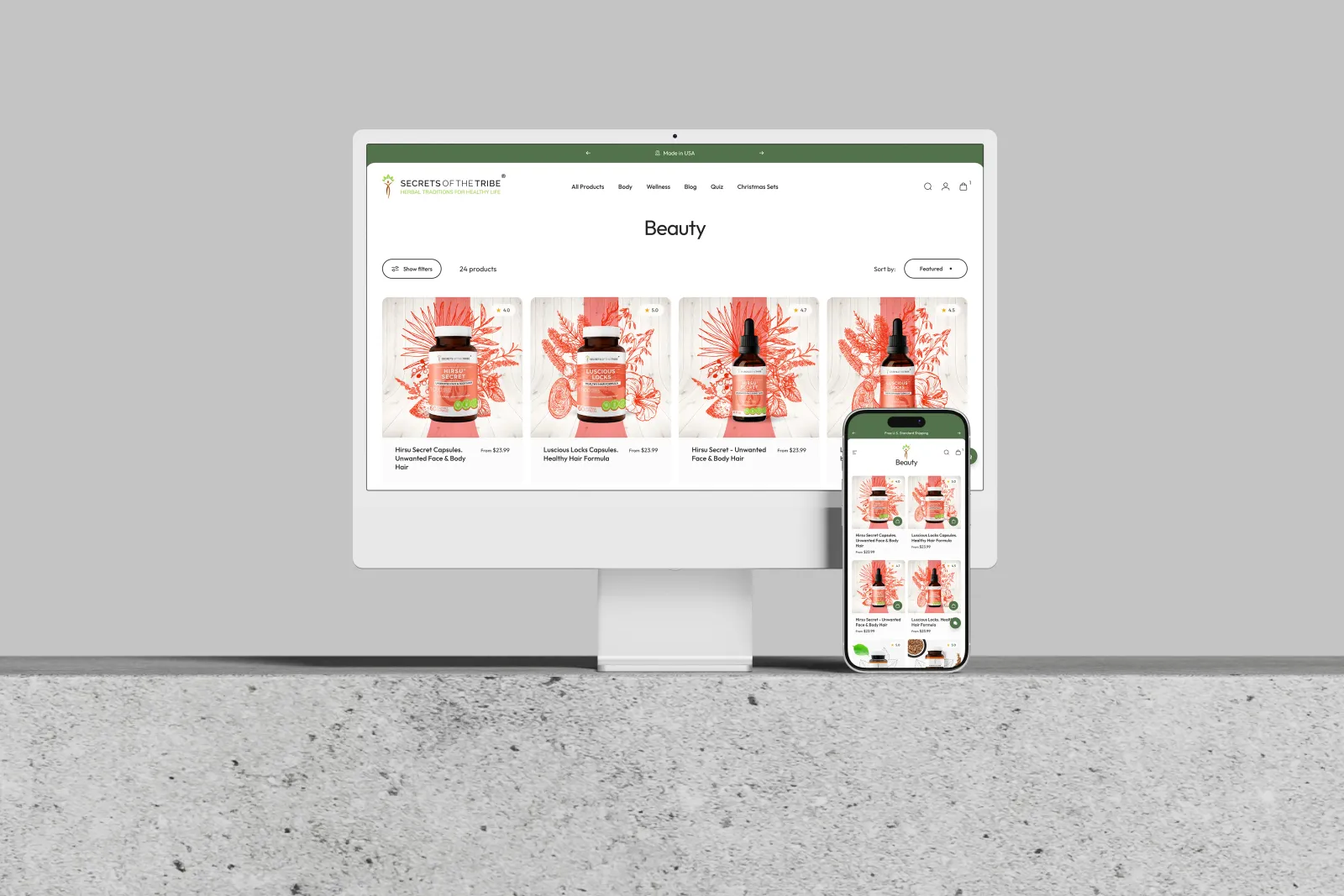
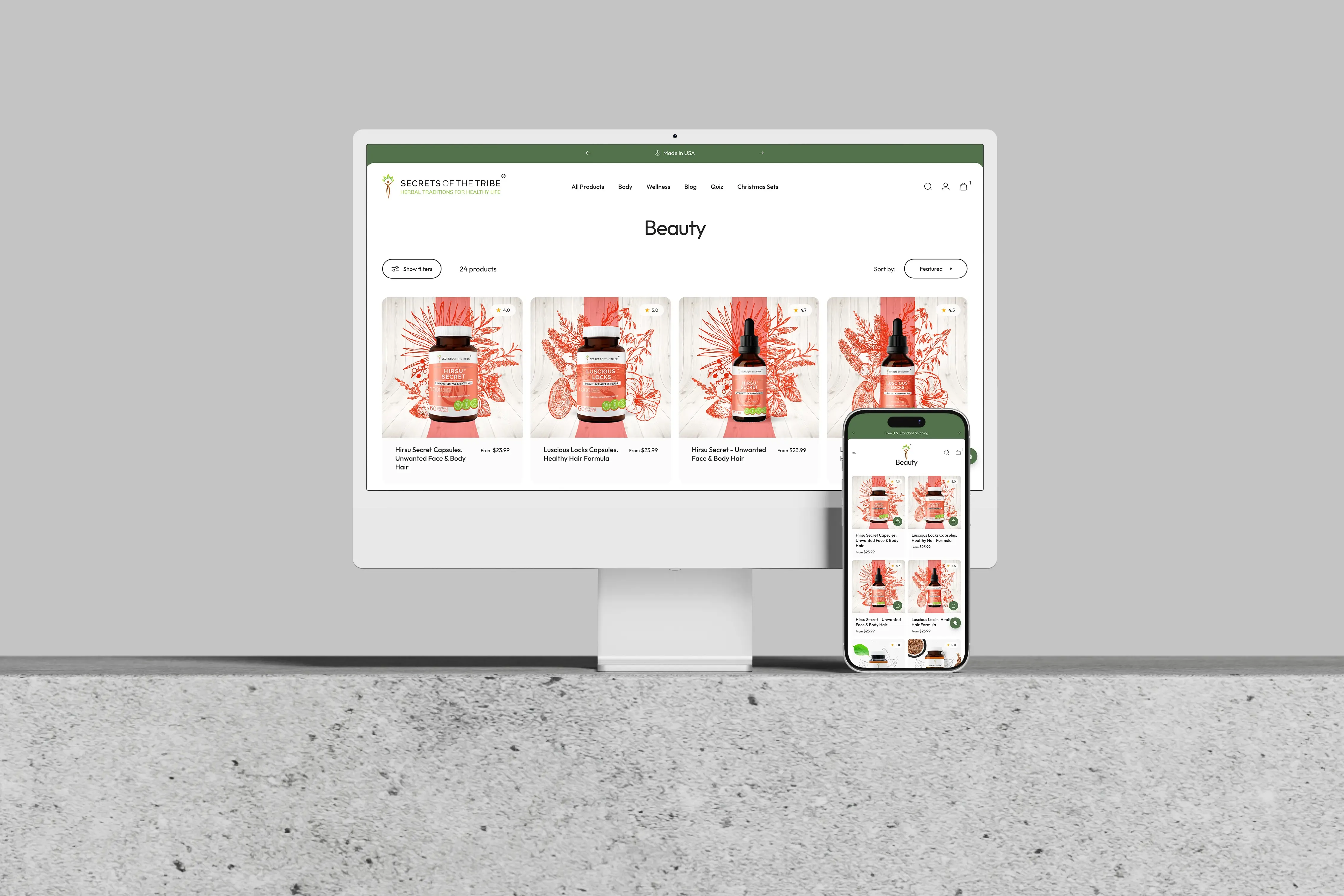 The finished product: Premium botanical design with trust signals front and center
Would This Work for Your Business?
Here’s how to know if this approach would apply to you.
This approach works well if:
- Your website looks outdated compared to your actual business quality
- Customers struggle to find what they need in your product or service catalog
- You compete against bigger players with more polished websites
- You have strong reviews and customer loyalty but your site doesn’t show it
- Your site loads slowly or feels clunky on mobile
- You’re losing potential customers to first impressions, not substance
This approach works less well if:
- Your main problem is getting traffic (not converting it)
- You have fewer than 20 products or services (simpler solutions exist)
- Your business model is changing significantly (nail that first, then build the site)
- Your budget requires a template solution (I can recommend good options instead)
Questions to ask yourself:
- If a customer visited my competitor’s site and then mine, what would they assume?
- How easy is it for someone to find exactly what they need in 30 seconds?
- Do my credentials and reviews show up before customers have to scroll?
- Does my site work as well on a phone as on a computer?
- When was the last time my site was meaningfully updated?
If your answers concern you, that’s useful information.
Common Questions
Frequently Asked Questions
This project took 3 months from kickoff to launch. That included competitive analysis, UX/UI design, development specifications, and implementation by my development partner. Timeline depends on catalog size, custom features needed, and how quickly approvals happen on your end. A simpler project might take 6-8 weeks. A more complex one could take 4-5 months.
I don't share client budgets publicly, but I'll tell you this: website redesigns like this typically fall in the $12,000-$18,500 range depending on complexity. That's strategy, design, and development together. No hidden fees, no 'phase 2' surprises. Check out my [website design services](/services/website-design/) for more details.
Yes. I handle the strategy, competitive analysis, UX/UI design, and specifications. For Shopify development, I partner with ESEO Space in San Diego, who has built 40+ websites with me over four years. You get the best of both: strategic design from me, expert Shopify development from specialists.
Absolutely. Secrets of the Tribe had 547+ products. The challenge isn't the product count; it's product discovery. I build filtering systems, AI-powered recommendations, and search functionality that helps users find exactly what they need. Large catalogs done right become a competitive advantage.
For Secrets of the Tribe, it was 31 pages covering: competitive UX audit, pricing comparison, information architecture analysis, content gaps, trust signal placement, and strategic positioning recommendations. It's not a template. It's research that drives every design decision. The analysis alone often reveals opportunities worth more than the investment.
Slow sites lose sales. Google measures loading speed (LCP), interactivity (INP), and visual stability (CLS). Studies show that every additional second of load time costs about 7% in conversions. Secrets of the Tribe passed all three metrics on both mobile and desktop. Mobile LCP of 1.6 seconds means customers see products fast, not loading spinners.
Yes, when done correctly. Secrets of the Tribe maintained their 3,200+ ranking keywords and actually grew to 3,277 keywords with 49+ Position 1 rankings after launch. Proper redirects, URL structure planning, and SEO-informed design are built into my process. Most agencies skip this because they don't understand SEO. They're just designers who installed a theme. Then you lose rankings and they blame Google.
Theme developers implement; they don't strategize. Before any design work, I spent time understanding what Gaia Herbs does well, where Secrets of the Tribe was losing, and what opportunities existed. The 31-page competitive analysis isn't something a theme developer provides. Strategy comes before pixels. If you just need a theme installed, you don't need me, and I'll tell you that upfront rather than take your money anyway.
I design a multi-attribute filtering system: category, form factor (tincture, capsule, etc.), health concern, and key ingredients. Users can narrow 300+ products to exactly what they need in 2-3 clicks. Plus an AI product recommendation agent for users who don't know where to start. The filters are based on how your customers actually shop, not how your inventory is organized.
I design the experience; development partners build the features. For Secrets of the Tribe, ESEO Space built the AI product recommendation agent and product-matching quiz. These aren't gimmicks. They solve a real problem: 'I don't know what I'm looking for.' AI helps users discover products they wouldn't have found otherwise.
Secrets of the Tribe competes with Gaia Herbs, a $50M+ company with 38 years of heritage. They don't have to outspend Gaia. They need to out-execute on product discovery and user experience. Large competitors often have slow, bureaucratic websites. That's the opportunity. Speed and focus beat size.
Not Ready Yet?
That’s completely fine. Here’s how to get value from this case study even if you’re not ready to start a project.
Do this now (free):
- Visit your own website on your phone and time how long it takes to find a specific product
- Compare your site to your top competitor’s site, side by side
- Ask a friend who’s never seen your site to describe their first impression in three words
- Check your Google PageSpeed Insights score (just Google it and paste your URL)
Gather these for when you’re ready:
- A list of your main competitors and their website URLs
- Your current traffic numbers (Google Analytics or Shopify dashboard)
- Your best and worst performing products by sales volume
- Customer complaints or questions that suggest website confusion
When you’re ready to talk:
I’ll take an honest look at what’s working, what’s not, and what fixing it might cost. 48-hour turnaround. No sales pitch.
I’ve been doing this for 15 years. I’ll still be here when the timing is right for you.
Is Your Website the Bottleneck?
If you have strong products or services, good customer reviews, but a website that doesn’t reflect your quality, you’re leaving money on the table every day.
The business isn’t the problem. The presentation is.
Here’s my offer: 30-Day Proof Period. We define what “measurable progress” means for YOUR business before we start. If you don’t see it, you get every penny back. No questions. No hassle.
Why? Because I know what I’m doing. And agencies that actually deliver don’t need long contracts to keep clients.
Start Your 30-Day Proof Period
48-hour turnaround. No sales pitch.
Or, see more results from businesses that fixed their bottlenecks.
Case study by
Kristian Kreaktive
Founder & Lead Strategist at Digital Marketing Services
17+ years of experience helping small businesses grow their online presence through strategic SEO, web design, and branding.

In collaboration with
eSEO Space
Design & Development
This project was created in collaboration with eSEO Space, combining our strategic approach with their technical expertise to deliver exceptional results.
Learn more about our partnershipMore Web Design Success Stories

Website Redesign That Turns a Product Catalog Into a Lead Engine
A product catalog that actually generates quote requests instead of just displaying inventory
 Featured
How a CPA Firm Captured 991 Top-3 Google Rankings and 175 AI Overview Citations
991 keywords in top 3, 175 AI Overview citations
When the Logo Tells the Whole Story: Clean Cut Renovations
One logo concept that expanded into a complete brand identity and custom website